|
The one common
denominator that all individuals who berate, disparage, and condemn the Old
South and the Confederacy exhibit is ignorance. Slavery is the issue they
concentrate and dwell upon. However, such ignorance is understandable
because American history books written by biased Northern professors have
not presented Southern and Confederate history in a fair and impartial
manner. However, such individuals usually exhibit extreme hardheadedness and
resistance to facts, data, and information that challenges their opinions
which are based on feelings, emotions and biased history.
The United States of America offered the Confederate States of America the
Corwin Amendment to the U.S. Constitution on March 2, 1861, which would have
been the original 13th Amendment. It would have made slavery a
constitutional and permanent institution. The Confederacy could have
accepted the Corwin Amendment and rejoined the Union thus permanently
keeping slavery. War would not have been necessary. However, the Confederacy
rejected this Amendment because slavery was only a side issue used as a
scapegoat for all the differences that existed between the North and South.
Excess taxation in the form of an unfair sectional tariff was one of the 10
major political reasons for Southern secession. The South was forced to pay
75% to 85% of the tax money to operate the federal government. The Southern
States were being treated as agricultural colonies and bled dry. This abuse
was almost as abject as the treatment of the European provinces under their
Roman Proconsuls 2,000 years ago.
The Confederacy fought to maintain constitutional limited federal
government, states' rights, and honesty and fidelity in public officials as
established by America's Founding Fathers, who were primarily Southern
gentlemen from
Virginia.
They were not willing for a dominant political party of the North to rule
the South. The Confederacy fought for the principal of self-government. It
was as noble and honorable a cause as has ever been fought for in human
history. On a human level the war was caused by New England greed,
hypocrites, fanatics, zealots, and radicals. It was New England that was
responsible for the establishment of slavery in America. During the colonial
era, the economic infrastructure of the port cities of
New England depended upon the slave trade.
..................................................................................................
In Defense Of Our Flag
One Man's Reply
From:
cliftonpalmermclendon@yahoo.com
'Stars and Bars' still used as racist
emblem
http://www.baltimoresun.com/news/opinion/letters/bal-ed.le.letters01d23dec01,0,2488305.story
[In re "'Stars and Bars' still used as racist emblem" by Bill Duff of
Cockeysville]
Rather
than being so Cockey-sure of himself, our Mr. Bill needs to get off his Duff
and check his facts.
The only Confederate
Flag I have ever seen used to jeer at people is the Confederate Battle Flag
(the one with the red field and the big starry blue X outlined in white).
That Flag is sometimes called "The Southern Cross" or "St. Andrew's Cross."
"The Stars and Bars" is
the nickname of the first National Flag of the Confederate States of
America. It had three wide horizontal bars of red-white-red and a blue
canton with stars in a circle. (The latest Georgia flag is the Stars and
Bars with the Georgia seal added in gold.)
RACISM: The assumption
that psychocultural traits and capacities are determined by biological race
and that races differ decisively from one another which is usually coupled
with a belief in the inherent superiority of a particular race and its right
to domination over others [from Webster’s Third New International Dictionary
of the English Language Unabridged (Chicago: Encyclopaedia Britannica, Inc.;
1981)]
Many people believe that
the Confederate Battle Flag is a symbol of racism because some groups --
such as the Ku Kluxers and the American Nazi Party -- that make no bones
about their belief in the inherent superiority of the Caucasian race and its
right to domination over others display that Flag.
Such groups also
sometimes display the United States Flag. Moreover, other people display
the Confederate Battle Flag for other, benign reasons. A flag, or any other
symbol, has only such meaning as is assigned to it by those who use it.
The Confederate States
of America never advocated as a national policy anything resembling a belief
in the inherent superiority of a particular race and its right to domination
over others. That nation spent its entire four year existence battling for
its survival. Moreover, several different ethnic groups contributed to its
struggle for survival.
While Confederate Flags
were not used during the existence of the Confederate States of America to
carry out actions designed to further a belief in the inherent superiority
of a particular race and its right to domination over others, other flags
have been so utilized over the years:
The one best example of
a flag under which one race asserted its superiority and its right to
dominate others is the flag of the United Kingdom of Great Britain and
Northern Ireland, a/k/a the Union Jack. Under this flag, the aboriginal
peoples of the Americas, Australia, various islands, and large parts of
Africa and Greater Asia were subjugated. Many slaves, African and
otherwise, were transported by ships flying this flag or a variation
thereof.
Under the tricolor of
France, various islands and large parts of Africa were “colonized.”
Under the flags of
India, Mexico, and Turkey, ethnic minorities within those countries’ borders
were hunted down and killed.
Under the flag of the
United States of America, a/k/a Old Glory, various leaders waged aggressive
wars of conquest against various nations and peoples during the 1800s.
Military commanders under this flag repeatedly encouraged murder, rapine,
plunder, and other atrocities against those they attacked. Vast numbers of
slaves were transported under this flag (most of them to the West Indies and
South America).
The aboriginal peoples
of no continent or island were subjugated under a Confederate flag.
No ethnic group was ever
hunted down and killed under a Confederate flag’s authority.
No slave
ship ever sailed under a Confederate flag.
No
Confederate flag ever oversaw any attempt at colonization.
No aggressive war of
conquest was ever prosecuted under a Confederate flag.
No military commander
serving under a Confederate flag ever encouraged atrocities against the
enemy.
…so how can Confederate
flags honestly be called symbols of racism?
Mr. Duff has not shown
that the people who objected to his choice of home-buyers believed that
their race was superior and had the right to rule over others, so he has no
grounds to accuse them of racism. All he has shown is that they prefer
their own culture to another culture, much as a New Englander might prefer a
clambake to an Oktoberfest, or a Texan might prefer a barbecue to an opera.
The quality of preferring one’s own culture to another is ETHNOCENTRISM.
Mr. Duff goes on to
state that the neighbors who agreed with his decision “placed real American
(Stars and Stripes) flags around their properties” – thus implying, if not
blatantly stating, that the Confederate Battle Flag is neither real nor
American.
Unless Mr. Duff
maintains that the Confederate Battle Flag is imaginary (which statement
would be, to say the least, difficult to support), it follows that that Flag
is real. As for its not being American, unless Mr. Duff wishes to go on
record as stating that the nation whose army used that Flag was located in
Europe, Asia, Africa, Australia, or Antarctica, or on the isles of the sea
(another difficult-to-support statement), it follows that the Flag in
question is undoubtedly American.
As for the
thirteen-stripe Flag’s being “well-understood to stand for liberty and
justice for all”:
• Take a look at
http://pointsouth.com/csanet/kkk.htm. See all of the thirteen-stripe
Flags? See who is using them? Do those people’s actions show liberty and
justice for all?
• Consider the
people of Georgia – killed and robbed and raped by soldiers serving under
the thirteen-stripe Flag. Did that Flag mean liberty and justice for the
people of Georgia?
• Consider the
Native Americans – forcibly divested of their lands, killed off, and starved
into submission by soldiers serving under the thirteen-stripe Flag. Did
that Flag mean liberty and justice for the Native Americans? Is it not clear
that the thirteen-stripe Flag’s government made it clear that their race
(Caucasian) was superior and had the right to rule over the Native Americans
– the very definition of “racism?”
• Consider many
of the prominent men of Maryland in the 1860s – thrown into the dungeon upon
the sole whim of the President of the nation flying the thirteen-stripe
Flag. Did that Flag mean liberty and justice for those Sons of the Old
Line?
• Consider the
Nisei and Sansei (native-born United States citizens whose parents and
grandparents had been born in Japan) in World War II – how they were
forcibly removed from their homes and sent to concentration camps where they
were crowded into tar-paper shacks. Did that Flag mean liberty and justice
for the Nisei and Sansei?
• Consider that,
until 1948, the military forces of the thirteen-stripe Flag’s nation were
segregated by race – while forces serving under the Confederate Battle Flag
were composed of a mélange of Caucasians, Negroes, Hispanics, Native
Americans, and even some Asians.
Remember: No Confederate
body -- military or civil -- ever committed atrocities upon enemy
noncombatants, or forcibly removed anyone from his homeland based on his
ethnicity, or dungenoned anyone for his political beliefs.
If anyone can show how
the thirteen-stripe Flag which oversaw all of the above unkindnesses
symbolizes liberty and justice for all, while the Confederate Battle Flag,
which oversaw none of the kind, symbolizes evil, I ask to be instructed at
CliftonPalmerMcLendon@yahoo.com.
Puttin’ the Skeer on
‘Em!
Fat Mack
Clifton Palmer McLendon
Pvt. (#729), 1st Bn Co. C, SCVMC
............................................................
"Brief
History of the Ku Klux Klan, Focusing on Their Use of the Flag"
by Jeffrey Todd McCormack
mash here
.............................................................
The
Confederate battleflag is undeniably the most recognized symbol of the
South, not only in the South, but in the United States and across the globe.
No other region in the United States has a symbol, much less a symbol so
universally recognized. Until political correctness came along, and the
agenda of social engineers to homogenize the United States, schools across
the South played "Dixie" proudly. If you look at movies made in the 30s through the 60s you
will hear "Dixie" and see the
battleflag as sentimental symbols of regional pride used to stir the martial
attitudes of much of the nation. When the wall fell in Berlin at the end of
the Cold War, the Confederate battleflag was there! Why? Because across the
world, the crimson flag is a symbol of opposition to an oppressive
government!
.............................................................
(Kindness of Billy. I am a KA, but
national headquarters has now turned politically correct which is a far cry
from when my brother pledges and I defended the Battle Flag hoisted on a
telephone pole in our house's backyard 24/7 from pledges of other
fraternities during Hell Week. BT)
"One can accept the interpretation of entire
states, Southern rock and country bands, NASCAR fans, Kappa Alpha
fraternities, thousands of reenactors and a century of thoughtful
historians."
From:
DixieCol@aol.com
To:
JFrancais@yahoo.com
Sent: Tuesday, August 05, 2008 8:31 PM
Subject: The Confederate flag: History -v- Hysteria
The Confederate flag: History -v- Hysteria
For the average non-Southerner, like you, the
continued affection residents of Dixie display toward the controversial
Battle Flag can be baffling. If African-Americans are so incensed by the
banner, why not just fold it up and put it away? Why indeed? The war has
been over for 137 years. Certain unsavory groups of a racist stripe seem
unduly attached to the symbol as well. No one in the print or electronic
media seems willing to come forward and offer a counterpoint. Is there
another point of view after all?
Newspapers however, and writers like you, have
developed the habit of concluding all flag related stories the same way. The
throwaway line for the other point of view is usually something like "flag
defenders say the banner stands for heritage". But what does that mean? If
such an understanding can be developed is it still not overshadowed by
prevailing negative opinions? Can a symbol so emotionally charged ever be
mutually understood?
Therein lies the problem. The very same symbol means
completely different things to different people. Perhaps the best place to
start is there. Many hate groups have gravitated toward the historical flag.
But it is also true these very same groups also use other symbols that are
loved and cherished by millions of people. The pinnacle of the Ku Klux Klan
was in the 1920s. They boasted over a million members with national
leadership in Ohio and Illinois. Yet the most careful photographic scrutiny
of the era will fail to reveal a single Confederate flag. One will however
find the American flag and the Christian cross in profusion. These symbols
are mainstays even today for hate groups. The difference is that patriotic
Americans and Christians already have a context for these symbols. The icons
cannot be co-opted because they already mean something else. This is also
precisely why Southerners continue to love the Battle flag in the face of so
much bad publicity. The flag already has meaning and context.
In fact, what the shamrock is to the Irish or the
Star of David is to Jews, the Battle Flag is to most Southerners. There is
enough historical baggage to encumber any of these symbols, but there is
more to admire. The Confederate flag embodies religion, ethnic heritage,
early-American revolutionary ideology and ultimately familial sacrifice on
the battlefield. The circumstances that gave it birth are the touchstone of
the regions identity, no different than the potato famine for the Irish or
the holocaust for the Jew. To examine the flag, in historical and ethnic
context should permit all but the most rabid flag-haters an opportunity to
understand what is behind the vague explanation of "heritage".
While the Battle flag did not make its appearance in
its recognizable form until 1862, some of the design elements date to
antiquity. The "X" is the cross of St. Andrew. It was the fisherman Andrew
who introduced his brother Simon Peter to Jesus in Galilee 2000 years ago.
When the disciple Andrew was himself martyred years later he asked not to be
crucified on the same type of cross Christ died upon. His last request was
honored and he was put to death on a cross on the shape of the "X". Andrew
later became the patron saint of Scotland and the Scottish flag today is the
white St. Andrews cross on a blue field. When Scottish immigrants settled in
Northern Ireland in the 1600s the cross was retained on their new flag,
albeit a red St. Andrews cross on a white field. When the New World opened
up landless Scots and Ulster-Scots lefts their homes and most of them
settled in the South, preserving their old culture in the isolated rural and
frontier environment.
Grady McWhiney explains in his book Cracker Culture,
that fully 75% of the early South was populated by these Celts. Most sold
themselves into indentured servitude (the earliest form of American slavery)
because they could not afford the cost of passage. This explains why only 6%
of the African slaves brought to the New World ended up in the American
colonies. The lowland English of Saxon descent by contrast settled the
Northeastern colonies. This imbued those colonies with such an English
character they are still known as New England. Urban, commercial and
materialistic by nature these Yankee descendants could not have been more
different than their Southern countrymen. Many historians believe the
longstanding historical animosities between Saxon and Celt did not bode well
for the new country. With this historical perspective the St. Andrews cross
seems almost destined to be raised again as ancient rivals clashed on new
battlefields.
From this Celtic stock, the ingredients that made the
unique Southern stew were gradually introduced. The American Revolution
unleashed Celtic hatred of the redcoat. Southerners penned the Declaration
of Independence, chased the British through the Carolina's and defeated them
at Yorktown. But they were dismayed when New England immediately sought
renewed trade with England and failed to support the French in their own
revolution. Another Virginian later crafted the Constitution, a document as
sacred to Southerners as their Bibles. Law, they believed finally checkmated
tyranny. The red, white and blue 13-starred banner was their new cherished
flag. These same features would later become a permanent part of the Battle
flag.
But all was not well with the new republic. Mistrust
between the regions manifested even before the revolution was over. The
unwieldy Articles of Confederation preceded the constitution. Two of the
former colonies (N.C and R.I.) had to be coerced into approving the latter
document after wrangling that included northern insistence they be allowed
to continue the slave trade another 20 years. Virginia and Kentucky passed
resolutions in 1796 asserting their belief that political divorce was an
explicit right. Massachusetts threatened on three separate occasions to
secede, a right affirmed by all the New England states at the 1818 Hartford
convention. The abolitionists were champions of secession and would burn
copies of the constitution at their rallies. Their vicious attacks upon all
things Southern occurring as it did in the midst of Northern political and
economic ascendancy animated Southern secessionists years before the average
Southerner could consider such a possibility.
Meanwhile Low Church Protestantism had taken root in
the South in the early 1800's and like kudzu has flourished until the
present day. Sociological studies conducted by John Shelton Reed of the
University of North Carolina scientifically prove that the South is still
the nations most religious region. Southerners are more likely to belong,
attend and contribute to their churches than Americans from any other
section. Calvinism is the main strain of religious thought and this
connection to Scotland and the St. Andrews cross is no coincidence. The
religious revivals that swept the Confederate armies during the war further
ingrained faith as a fixture of Southern character. During the same era
north of the Mason-Dixon transcendentalism, as expounded by Thoreau and
Emerson, the taproot of modern secular humanism, was displacing puritanical
religion as the dominant philosophical belief. The nation was also
fracturing along spiritual lines.
By 1860 the United States was in reality two
countries living miserably under one flag. When war broke out, Dixie's'
original banner so resembled the old American forebear that a new flag was
needed to prevent confusion on the field of battle. The blue St. Andrews
cross, trimmed in white on a red field appeared above the defending
Confederate army. Thirteen stars appeared on those bars representing the
eleven seceding states and revolutionary precedent. These fighting units
were all recruited from the same communities, with lifelong friends and
close relatives among the casualties of every battle. As they buried their
dead friends and relatives the names of those battles were painted or
stitched on their flags. At Appomattox a Union observer wrote, they were
stoic as they stacked their arms but wept bitterly when they had to furl
their flags.
Then, as now the flag symbolizes for Southerners not
hate but love; love of heritage, love of faith, love of constitutional
protections, love of family and community. If the 1860 census is to be
believed 95% of the slaves were owned by just 5% of the population. The
modern insistence that the conflict was to resolve the issue of slavery is
at best overstated and at worst revisionist. But the current argument does
deserve one more look.
The vitriolic, almost irrational antipathy toward the
flag is a recent phenomenon. Credible research reveals its origins to be in
the 1980's revived by a financially strained and scandal plagued NAACP.
Current President, Kwaise Mfume has turned the issue into a fundraising
juggernaut. Egged on by a liberal media irritated at the lingering
conservatism in the South, the flag fight has generated much heat but little
light. South Carolina relocated the flag from its capital dome to a place of
historical significance after they decided it flew in a position of false
sovereignty. Governor Hodges became the second governor in a row whose
broken promises to "leave the flag alone" scuttled their reelection bids.
Former Governor Barnes of Georgia finessed a backroom flag deal that for now
has changed the flag but sank his rising political star as outraged citizens
sent him to retirement in the 2002 elections. In Mississippi, however, the
thing was put to an old fashioned democratic vote. By a 2 to 1 margin and
outspent 10 to 1 they voted to keep the state flag, which features the
Battle flag. In fact, three times more African-Americans voted to keep the
flag than voted for President Bush. Mississippians speak for all Southerners
when they say "It's our symbol, its our heritage and therefore our choice".
In the end what people choose to believe about the
flag is just that, a choice. One can accept the interpretation of entire
states, Southern rock and country bands, NASCAR fans, Kappa Alpha
fraternities, thousands of reenactors and a century of thoughtful
historians. People can also embrace the interpretation of a few pathetic
racists and an opportunistic civil rights organization well amplified by a
sympathetic media. Like all choices its says less about the object than it
does about the person Perhaps only the Irishman can define the shamrock, or
a Jew explain the Star of David. Are not Southerners entitled to the same
latitude?
.................................................................
Equal Status for Confederate Veterans

Confederate veterans were afforded status
equal to that of United States
veterans by an act approved by the Congress of the United States of America
on
May 23, 1958, and signed into law by President Dwight D. Eisenhower, in
accordance with Public Law 85-425, thereby amending the Veterans' Benefit
Act of 1957.
Federal Statutes : US Law that defines status
of Confederate Veterans
Public Law 85-425 adopted May 23, 1958 as H.R. 358
AN ACT
To increase the monthly rates of pension payable to widows and former
widows
of deceased veterans of the Spanish-American War, Civil War, Indian War,
and
Mexican War, and provide pensions to widows of veterans who served in the
military or naval forces of the Confederate States of America during the
Civil
War...
CONFEDERATE FORCES VETERANS
Sec. 410. The Administrator shall pay to each person who served in the
military or naval forces of the Confederate States of America during the
Civil War
a monthly pension in the same amounts and subject to the same conditions as
would have been applicable to such... if such forces had been service in
the
military or naval service of the United States.
Sec. 2. This act shall be effective from the first day of the second
calendar month following its enactment.
Approved May 23, 1958.
..................................
  The
Truth about the Yankee War The
Truth about the Yankee War
The Civil War produced at least
two important outcomes. First, although it was not President Lincoln's
intent, it freed slaves in the Confederate States. Second, it settled,
through the force of arms, the question of whether states could secede from
the Union. The causes of and the issues surrounding America's most costly
war, in terms of battlefield casualties, are still controversial. Even its
name the - Civil War - is in dispute, and plausibly so.
A civil war is a struggle
between two or more factions seeking to control the central government.
Modern examples of civil wars are the conflicts we see in Lebanon, Liberia
and Angola. In 1861, Jefferson Davis, the President of the Confederate
States, no more wanted to take over Washington, D.C. than George Washington
wanted to take over London in 1776. George Washington and the Continental
Congress were fighting for independence from Great Britain.
Similarly, the Confederate States were fighting for independence from
the Union. Whether one's sentiments lie with the Confederacy or with the
Union, a more accurate characterization of the war is that it was a war for
southern independence; a frequently heard southern reference is that it was
the War of Northern Aggression.
History books most often say the
war was fought to free the slaves. But that idea is brought into serious
question considering what Abraham Lincoln had to say in his typical
speeches: "I have no purpose, directly or indirectly, to interfere with the
institution of slavery in the states where it exists. I believe I have no
lawful right to do so, and I have no inclination to do so." Slavery makes
for great moral cause celebre for the War Between the States but the real
causes had more to do with problems similar to those the nation faces today
- a federal government that has escaped the limits the Framers of the
Constitution envisioned.
South Carolina Senator John C
Calhoun expressed that concern in his famous Fort Hill Address July 26,
1831, at a time when he was Andrew Jackson's vice-president. Calhoun said,
"Stripped of all its covering, the naked question is, whether ours is a
federal or consolidated government; a constitutional or absolute one; a
government resting solidly on the basis of the sovereignty of the States, or
on the unrestrained will of a majority; a form of government, as in all
other unlimited ones, in which injustice, violence, and force must
ultimately prevail."
Calhoun's fear, as well as that
of Thomas Jefferson, was Washington's usurpation of powers constitutionally
held by the people and the states, typically referred to as consolidation
in their day. A significant bone of contention were tariffs enacted to
protect northern manufacturing interests. Referring to those tariffs,
Calhoun said, "The North has adopted a system of revenue and disbursements,
in which an undue proportion of the burden of taxation has been imposed on
the South, and an undue proportion of its proceeds appropriated to the
North." The fact of the matter was that the South exported a large
percentage of its output, mainly agricultural products; therefore, import
duties on foreign products extracted far more from the South than the North.
Southerners complained of having to pay either high prices for northern-made
goods or high tariffs on foreign-made goods. They complained about federal
laws not that dissimilar to Navigation Acts that angered the Founders and
contributed to the 1776 war for independence. Speaking before the Georgia
legislature, in November 1860, Senator Robert Toombs said, ". . . They
[Northern interests] demanded a monopoly of the business of shipbuilding,
and got a prohibition against the sale of foreign ships to the citizens of
the United States. . . . They demanded a monopoly of the coasting trade, in
order to get higher freight prices than they could get in open competition
with the carriers of the world. . . . And now, today, if a foreign vessel in
Savannah offer [sic] to take your rice, cotton, grain or lumber to New York,
or any other American port, for nothing, your laws prohibit it, in order
that Northern ship-owners may get enhanced prices for doing your carrying."
A precursor for the War Between
the States came in 1832. South Carolina called a convention to nullify new
tariff acts of 1828 and 1832 they referred to as "the tariffs of
abomination." The duties were multiples of previous duties and the
convention declared them unconstitutional and authorized the governor to
resist federal government efforts to enforce and collect them. After
reaching the brink of armed conflict with Washington, a settlement calling
for a stepped reduction in tariffs was reached - called the Great Compromise
of 1833.
South Carolinians believed there
was precedence for the nullification of unconstitutional federal laws. Both
Thomas Jefferson and James Madison suggested the doctrine in 1798. The
nullification doctrine was used to nullify federal laws in Georgia, Alabama,
Pennsylvania and New England States. The reasoning was that the federal
government was created by, and hence the agent of, the states.
When Congress enacted the
Morrill Act (1861), raising tariffs to unprecedented levels, the South
Carolina convention unanimously adopted and Ordinance of Secession declaring
"We assert that fourteen of the States have deliberately refused for years
past to fulfill their constitutional obligations. . . . Thus the
constitutional compact has been deliberately broken and disregarded by the
nonslaveholding States; and the consequence follows is that South Carolina
is released from her obligation. . . ." Continuing, the Ordinance declared,
"We, therefore the people of South Carolina, by our delegates in Convention
assembled, appealing to the Supreme Judge of the world for the rectitude of
our intentions, have solemnly declared that the Union heretofore existing
between this State and the other States of North America is dissolved and
that the State of South Carolina has resumed her position among the nations
of the world, as a separate and independent State, with the full power to
levy war, conclude peace, contract alliances, establish commerce and to do
other things which independent States may of right do." Next year war
started when South Carolinians fired on Fort Sumter, an island in the harbor
of Charleston, South Carolina.
The principle-agent relationship
between the states and federal government was not an idea invented by South
Carolina in 1861; it was a relation taken for granted. At Virginia's
convention to ratify the U.S. Constitution, the delegates said, "We
delegates of the people of Virginia, . . . do in the name and on the behalf
of the people of Virginia, declare and make known, that the powers granted
under the Constitution being derived from the people of the United States,
may be resumed by them whensoever the same shall be perverted to their
injury or oppression, and that every power not granted thereby remains with
them, and at their will. That therefore no right, of any denomination, can
be canceled, abridged, restrained or modified by the Congress, by the
Senate, or House of Representatives, acting in any capacity, by the
President, or any department or officer of the United States, except in
those instances where power is given by the Constitution for those
purposes." The clear and key message was: the powers granted the federal
government, by the people of Virginia, "may be resumed by them whensoever
the same shall be perverted to their injury or oppression" and every
power not granted to the federal government by the Constitution resides with
the people of Virginia. The people of Virginia, through their delegates, set
up a contractual agreement, along with the several sovereign states
(emerging out of the 1783 Treaty of Paris ending the war with Great
Britain), created the federal government as their agent. They enumerated the
powers their agent shall have. When the federal government violates their
grant of power, then the people of Virginia have the right to take back the
power they granted the federal government, in other words, fire their agent.
The War Between the States,
having settled the issue of secession, means the federal government can do
anything it wishes and the states have little or no recourse. A derelict
U.S. Supreme Court refuses to do its duty of interpreting both the letter
and spirit of the Constitution. That has translated into the 70,000 federal
regulations and mandates that controls the lives of our citizens. It also
translates into interpretation of the "commerce" and "welfare" clauses of
our Constitution in ways the Framers could not have possibly envisioned.
Today, it is difficult to think of one elected official with the statesman
foresight of a Jefferson, Madison or Calhoun who can articulate the dangers
to liberty presented by a run amuck federal government. Because of that,
prospects for liberty appear dim. The supreme tragedy is that if liberty
dies in America it is destined to die everywhere.
Walter E. Williams
Ideas on Liberty, January 1999
...........................................
Four Claims About the War
1. That Confederate soldiers
fought for states rights guaranteed under the Constitution.
2. That the people of the South seceded
in order to preserve their rights.
3. That the North (i.e., the Union)
resorted to coercion.
4. That the South fought against
overwhelming odds.
............................................
Secession
was NOT "treason!
"If you
bring these leaders to trial, it will condemn the North, for by the
Constitution, secession is not a rebellion. His [Jefferson Davis] capture
was a mistake. His trial will be a greater one. We cannot convict him of
treason."
-- Salmon
P. Chase, Chief Justice of the US Supreme Court, 1867
In this
modern era, one may read that the great Southern leaders were "traitors."
However, Robert E. Lee, Thomas J. "Stonewall" Jackson and Jefferson Davis,
all heroes of the Mexican War, were no more and no less traitors than
Washington, Adams and Jefferson were traitors to Great Britain. At the U. S.
Military Academy, the constitutional law book studied, "A View of the
Constitution of the United States" by William Rawle, a Philadelphia
abolitionist and Supreme Court Justice, taught that states had a right to
secede: "To deny this right would be inconsistent with the principle on
which all our political systems are founded, which is, that the people have
in all cases, a right to determine how they will be governed."
.......................................
West Virginia’s secession
was probably unconstitutional. See "Texas v White" (1869).
I happen to think that,
given that the country was founded on a claim of right to revolution, 'a
fortiori' an empirical social contract like the US Constitution and its 10th
Amendment give rise to a right of secession, morally and legally.
For a good scholarly piece
on the matter, see:
http://papers.ssrn.com/sol3/papers.cfm?abstract_id=371340
.......................................
Which
Side Was Right? Some Simple Questions
Q: Which side first seized and then occupied property that the other side
viewed as its own?
A: The North. (The federal occupation of Fort Sumter, Charleston, SC, on
December 26, 1860.)
Q: Which side first sent an unwanted, uninvited armed naval force into one
of the other side's ports in order to resupply a garrison that was occupying
a fort that the other side viewed as its own?
A: The North. (The armed naval convoy that Lincoln sent to Fort Sumter.)
Q: Which side sought
peaceful relations based on peaceful coexistence and a mutual respect for
the other's sovereignty?
A: The South. (The CSA sent a peace delegation to D.C. soon after it was
formed, but Lincoln wouldn't even meet with
the delegation.)
Q: Which side sent out
peace feelers and expressed a desire for peace even when it was winning on
the battlefield?
A: The South.
Q: Which side wanted to
make the other side its largest trading partner?
A: The South.
Q: Which side refused to
even discuss peaceful separation, peaceful coexistence, diplomatic
recognition, and good trade relations?
A: The North.
Q: Which side was willing
to let the other live under a government of its own choosing and merely
wanted the freedom to do the same?
A: The South.
Q. Which side sent an
invasion force into the other's territory?
A: The North. (That's why nearly all
the battles were fought in the Southern states.)
Q: Which side refused to
sell the other medicine, even though the medicine was to be used for the
other side's POWs?
A: The North.
Q: Which side deliberately
allowed thousands of the other side's POWs to freeze and/or starve to death,
even though it had ample supplies to keep the POWs alive?
A: The North.
Q: Which side had to
imprison over 20,000 to 30,000 of its own citizens, shut down two of its
state legislatures, suspend habeas corpus by executive order, shut down over
300 newspapers, imprison dozens of newspaper editors, and expel members of
its own House and Senate in order to suppress domestic opposition to its war
policies?
A: The North.
Q: Which side resorted to
large-scale warfare on the other side's civilian population and by this
warfare killed some 50,000 of the other side's civilians?
A: The North.
Q: Which side tried to
assassinate the other side's president and cabinet?
A: The North. (The Dahlgren raid.)
..................................
"No other war (Civil War) started so many controversies and
for no other do they flourish so vigorously. Every step in the conflict,
every major political decision, every campaign, almost every battle, has
its own proud set of controversies, and of all the military figures only
Lee stands above argument and debate. Recent years, however, have seen a
new kind of nastiness emerge in these disputes. Even the venerable Robert
E. Lee has taken some vicious hits, as dishonest or misinformed advocates
among political interest groups and in academia attempt to twist
yesterday's America into a fantasy that might better serve the political
issues of today. The greatest disservice on this count has been the
attempt by these revisionist politicians and academics to defame the entire
Confederate Army in a move that can only be termed the Nazification of the
Confederacy. Often cloaked in the argument over the public display of the
Confederate battle flag, the syllogism goes something like this:
Slavery was evil. The soldiers of the Confederacy fought for a system that
wished to preserve it. Therefore they were evil as well, and any attempt
to honor their service is a veiled effort to glorify the cause of slavery.
This blatant use of the race card in order to inflame their political and
academic constituencies is a tired, seemingly endless game that is itself
perhaps the greatest legacy of the Civil War's aftermath. But in this case
it dishonors hundreds of thousands of men who can defend themselves only
through the voices of their descendants."
James Webb - Capt USMC (ret) Vietnam Combat Veteran, Secretary of the Navy
for Reagan during the 1980s.
.............................
If Lincoln did not threaten slavery, why,
then, did the Deep South secede? Answer: by 1861, America had become two
nations and two peoples. The South had evolved into a separate civilization
and wished to be a separate country. While moderates like Lee did not
support secession, Southern militants concluded that, with the election of
Lincoln, the North had won the great struggle for control of the national
destiny; the South would never again determine the nation's direction.
This first Republican president had not received a single electoral vote in
a Southern state; in 10 Southern states he had not received a single vote.
Lincoln owed the South nothing; but he owed everything to her enemies, to
the admirers of John Brown, to the Northern industrialists who had Lincoln's
commitment to a protective tariff that threatened the South's ruin.
After decades of a troubled and unhappy marriage, Lincoln's election was the
final blow for most Southerners. They decided, irrevocably, on divorce.
"The American people, North and South,
went into the War as citizens of their respective states, they came out as
subjects... what they thus lost they have never got back." ~H.L. Mencken
The degree to which Americans are now indebted to, and dependent on, the
federal government is a most bitter reminder of the Confederacy's failure.
But we have failed in a deeper sense. We, like many Americans, have in our
ignorance abetted in the practical destruction our founders' Constitution.
Having surrendered liberty, we are no longer entitled to its blessings. So
please do not speak of slavery. We have stripped ourselves of our knowledge,
pride and heritage. We have shamed and prostrated ourselves, and, to no
small degree, it is we who are now enslaved.
"It is said slavery is all we are fight
for, and if we give it up we give up all. Even if this were true, which we
deny, slavery is not all our enemies are fighting for. It is merely the
pretense to establish sectional superiority and a more centralized form of
government, and to deprive us of our rights and liberties." ~Major General
Patrick R. Cleburne, CSA (2 January 1864)
McClellan sought to avoid bringing slavery
into the conflict. Shortly after his appointment as general-in-chief he
informed his political friends in Washington of his true outlook: “Help me
to dodge the n_____ -- we want nothing to do with him. I am fighting to
preserve the integrity of the Union & power of the Government -- on no other
issue.” ~General George B. McClellan (1862).
Union General Ulysses S. Grant is widely quoted as having written, in an
1862 letter to the Chicago Tribune, that "the sole object of this war is to
restore the Union. Should I become convinced it has any other object, or
that the Government designs its soldiers to execute the wishes of the
Abolitionists, I pledge you my honor as a man and a soldier I would resign
my commission and carry my sword to the other side."
(Jeff Riggenbach, "Why the Terrible Destruction of the Civil War" (Ludwig
von Mises Institute: May 6, 2011)
http://mises.org/mobile/daily.aspx?Id=5248
If the words of Lincoln, Grant and McClellan do not convince you that
slavery was not the reason for the War what others said would likely not
change your mind. However, slavery was legal in the United States and the
Corwin Amendment, strongly endorsed by Lincoln and approved by both houses
of the U. S. Congress on March 2, 1861, would have ensured its continuance
in perpetuity. There was absolutely no reason for the South to secede if
slavery had been the issue. It was not, however; rather it was the desire
for independence.
We should understand that the issue of slavery was not the cause of
Southern secession or the reason for the War. The South did not want to
protect slavery from a Northern attempt to abolish it, because no such
attempt was ever intended or expressed by any serious party, and indeed
Congress in July 1861 had explicitly defended the continuance of the
institution. Nor did the South want to extend slavery into the Western
territories because it was clear it was neither a useful nor a welcome
practice there, and besides when it formed the Confederacy it no longer had
any constitutional claim to influence in those sections.
.............................
Slavery existed in the colonies under the
English flag for 150 years before the American Revolution and for many years
after the Revolution under the United States flag. If there is any
contrition it should be with those ultimately responsible:
King Gezo of Dahomey (a country in west Africa now called the Republic of
Benin) said in the 1840s, "The slave trade is the ruling principle of my
people. It is the source and the glory of their wealth...the mother lulls
the child to sleep with notes of triumph over an enemy reduced to
slavery....
In 1807, the British Parliament passed the
Abolition of the Slave Trade Act. The King of Bonny (now in Nigeria) was
horrified: "We think this trade must go on. That is the verdict of our
oracle and the priests. They say that your country, however great, can never
stop a trade ordained by God himself."
Wilmot, explained to King Gelele: "England
has been doing her utmost to stop the slave trade in this country. Much
money has been spent, and many lives sacrificed to obtain this desirable
end, but hitherto without success. I have come to ask you to put an end to
this traffic and to enter into some treaty with me."
Gelele refused: "If white men came to buy, why should I not sell?" Wilmot
asked how much money he needed. "No money will induce me...I am not like the
kings of Lagos and Benin. There are only two kings in Africa, Ashanti and
Dahomey: I am King of all the blacks. Nothing will compensate me for the
loss of the slave trade."
Gelele also told Burton, "If I cannot sell my captives taken in war, I must
kill them, and surely the English would not like that."
.............................
Compatriots and Brothers in the Cause:
Let's see if I understand correctly.
They have the NAACP.
They have NCF (National Negro College Fund).
They have the Black Panthers, which at times will march down the street
carrying rifles like a blooming army
Then there's Malcom X
They have the Rainbow Coalition
They have the Association of Black Mayors, Black Ministers, etc.
They have MLK, Jr.'s birthday as a national holiday. The only American so
honored.
They have streets, buildings, parks, etc. all over the country named "MLK"
this or that.
They have February designated as National Black History Month.
In Texas they have something called Juneteenth, which has something to do
with the freeing of slaves in Texas.
I'm sure we can add to the list, but we've got the idea.
Now, what is it we ask?
All we ask is to celebrate our heritage, and honor our brave and noble
ancestors.......AND THEY GET OFFENDED!
They call us bigots, racists and hate mongers. They call the CBF and our
beloved historic statues, monuments and museums symbols of hate, lawlessness
and slavery. They insult us and debase us at every opportunity.
AND THEY ARE OFFENDED!
............................................
The
South Under Siege 1830-2000
-
http://collards.phantacom.net
.........................................
For many years now I have questioned the antics of
modern-day civil rights groups who have fulfilled their stated purpose &
mission of winning civil rights for their people. They won the same rights
as every other American with the passage of the 1964 Civil Rights Act.
Mission accomplished and mission completed or so one would have thought.
Coming off this fresh victory & up until the present day these groups keep
making phrases like, "the dream is not finished," & "we still have along
way to go!" A long way to go to reach what?
Your civil rights were won in 1964. Hence their uproar over much about
nothing continues or, is it really about nothing? Since these groups have
the same rights as every other American lets examine what it could be that
these groups think is not finished. Could it be that they think, "in order
for them to win, all others must fail?" So, the attacks on all things
related to the South's history, heritage, culture & symbols? Or is their
actual cause a racist one, tightly hidden & shielded from the public under
the mantra of "pursuing civil rights?" Is being equal in the eyes of the
law not good enough for these groups & they use the battle cry of the civil
rights movement as a cover & means
to gain a leg up on everyone else & eventually achieve their own form of
racial supremacy over every other American? For those who would read this &
think me a racist let me remind you that, honest observation is not racism.
If my ideas are wrong about these so - called modern-day " civil rights"
groups, then please explain to me what rights do we have that they do not
have?
.....................................
Why doesn't Senator Clinton call for the
banning of the New York state flag, which features two slave ships in the
center? The state seal, which is the state flag, was adopted in 1798 when
New Yorkers were making money hand over first importing slaves into both New
York City and The South. In 1798 New York City was the second largest
destination for importation of slaves, second only to Charleston, S.C.
Senator Clinton should read up on her history before condemning The South.
...............................................
Honestly, Abe!
Don't blame the South for Abe Lincoln's war
I have four comments concerning Daniel Augustine's letter to
the editor ["Let's not misrepresent Abraham Lincoln, OK?" Feb. 20].
First of all, there was not an insurrection in the South.
The Southern states simply seceded and wished to be left alone, as Jefferson
Davis so eloquently stated.
Second, Lincoln's armies did indeed "lay waste to our land,"
as the burned houses and barns throughout the Shenandoah Valley well
attested.
On top of that, approximately 50,000 Southern civilians of
all colors died because of this invasion.
Next, his statement that the Civil War was fought over
slavery is best rebutted by the following two quotes from Dickens and Marx.
"The Northern onslaught upon slavery was no more than a
piece of specious humbug designed to conceal its desire for economic control
of the Southern states."--Charles
Dickens.
"The war between the North and the South is a tariff war.
The war is further not for any principle, does not touch the question of
slavery, and in fact turns on the Northern lust for sovereignty."--Karl
Marx
Finally, although the South did fire first, this was
cleverly induced by Lincoln, as this quote will show.
"You and I both anticipated that the cause of the country
would be advanced by making the attempt to provision Fort Sumter, even if it
should fail; and it is no small consolation now to feel that our
anticipation is justified by the result."--Lincoln,
in a letter to Gustavus Fox on May 1, 1861.
Brock Townsend
................................................
To those who yet contend that Lincoln and
the Union went to war "to make men free," how do they respond to the fact
that when the war began, with the firing on Fort Sumter, there were more
slave states inside the Union (8) than in the Confederacy (7)? Four Southern
states, Virginia, North Carolina, Tennessee, and Arkansas, had remained
loyal. They did not wish to secede; they did so only after Lincoln put out a
call for 75,000 volunteers for any army to invade and subjugate the Deep
South.
................................................
An
Understanding of Southern Men
Sen. Hoar of Massachusetts, speaking of the South on the
floor of the U. S . Senate on the 23rd of February, 1889. Sen. Hoar did not
understand the South and its problems before, during and after
Reconstruction, nor was he unbiased toward the South, but he sure did have a
good understanding of Southern men.
"They have some qualities which I cannot even presume to claim in an equal
degree for the people among whom I, myself, dwell. They have an aptness for
command which makes the Southern gentleman, wherever he goes, not a peer
only, but a prince. They have a love for home; they have, the best of them,
and the most of them, inherited from the great race from which they come,
the sense of duty and the instinct of honor as no other people on the face
of the earth. They are lovers of home. They have not the mean traits which
grow up
somewhere in places where money-making is the chief end of life. They have,
above all, and giving value to all, that supreme and superb constancy which,
without regard to personal ambition and without yielding to the temptation
of wealth, without getting tired and without getting diverted, can pursue a
great public object, in
and out, year after year and generation after generation."
..........................................
In
Defense of Gen. Forrest
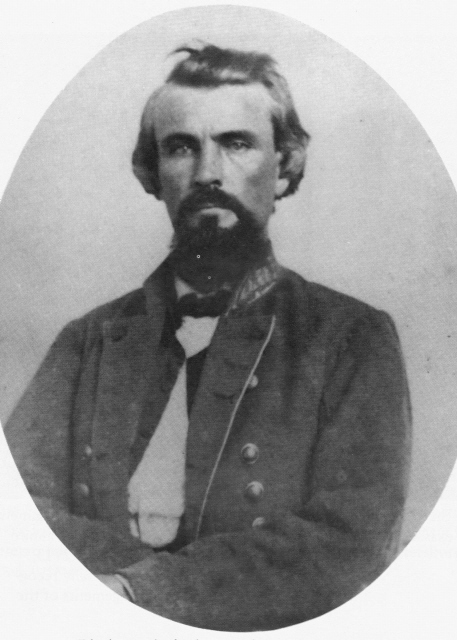
Gen. Forrest is the subject of a very old hoax that has been
around since the War. There is no truth to the rumor that he was ever
a 'leader of the kkk' or that he was a racist. When he was called to appear
at the 1871 US Congressional Committee that investigated the charges of his
rumored involvement with that group, he was building a railroad with most of
his workers being blacks, whom he paid better wages than other companies
were paying whites. He worked to promote civil rights for blacks, and for
all men; his speech to the Pole Bearers is proof of that.
That 1871 Committee cleared Forrest of all charges.
Here's part of the transcript of Forrest's testimony to that
1871 hearing:
"The reports of Committees, House of Representatives, second session,
forty-second congress," P. 7-449.
"The primary accusation before this board is that Gen. Forrest was a founder
of The Klan, and its first Grand Wizard, So I shall address those
accusations first. In 1871, Gen. Forrest was called before a congressional
Committee along with 21 other ex-Confederate officers including Admiral
Raphael Semmes, Gen. Wade Hampton, Gen. John B. Gordon, and Gen. Braxton
Bragg. Forrest testified before Congress personally over four hours .
Forrest took the witness stand June 27th,1871. Building a railroad in
Tennessee at the time, Gen Forrest stated he 'had done more , probably than
any other man, to suppress these violence and difficulties and keep them
down, had been vilified and abused in the (news) papers, and accused of
things I never did while in the army and since. He had nothing to hide,
wanted to see this matter settled, our country quite once more, and our
people united and working together harmoniously.'
Asked if he knew of any men or combination of men violating the law or
preventing the execution of the law: Gen Forest answered emphatically, 'No.'
(A Committee member brought up a document suggesting otherwise, the 1868
newspaper article from the "Cincinnati Commercial". That was their
"evidence", a news article.)
Forrest stated '...any information he had on the Klan was information given
to him by others.'
Sen. Scott asked, 'Did you take any steps in organizing an association or
society under that prescript (Klan constitution)?'
Forrest: 'I DID NOT' Forrest further stated that '..he thought the
Organization (Klan) started in middle Tennessee, although he did not know
where. It is said I started it.'
Asked by Sen. Scott, 'Did you start it, Is that true?'
Forrest: 'No Sir, it is not.'
Asked if he had heard of the Knights of the white Camellia, a Klan-like
organization in Louisiana,
Forrest: 'Yes, they were reported to be there.'
Senator: 'Were you a member of the order of the white Camellia?'
Forrest: 'No Sir, I never was a member of the Knights of the white
Camellia.'
Asked about the Klan :
Forrest: 'It was a matter I knew very little about. All my efforts were
addressed to stop it, disband it, and prevent it....I was trying to keep it
down as much as possible.'
Forrest: 'I talked with different people that I believed were connected to
it, and urged the disbandment of it, that it should be broken up.'"
The following article appeared in the New York times June 27th, "Washington,
1871. Gen Forrest was before the Klu Klux Committee today, and his
examination lasted four hours. After the examination, he remarked than the
committee treated him with much courtesy and respect."
Actually, the "kuklos" was started in Pulaski, Tennessee, just before
Christmas 1865, by six ex-Confederate officers, and was a sort of social
club for Confederate officers.
Gen. Forrest was NOT the 'first Grand Wizard of the KKK". For the correct
information on that, here are the actual documented facts :
Bedford Forrest had absolutely nothing to do with the founding of the Ku
Klux Klan. And even within the history of the Klan, differences must be
noted between the Klan of the 1860s and the Klan of today.
The KKK that was reorganized in 1915 had a well-deserved reputation as a
bigoted and sometimes violent organization, fueled by hate and ignorance and
thriving on fear and intimidation. But that wasn't always the case. The
original KKK of the 1860s was organized as a fun club, or social club, for
Confederate veterans. Many historians agree that if a YMCA had been
available in the town of Pulaski, Tenn., the KKK might never have existed.
On Dec. 24, 1865, six young Confederate veterans met in the law office of
Judge Thomas M. Jones, near the courthouse square in Pulaski. Their names
were James R. Crowe, Calvin E. Jones, John B. Kennedy, John C. Lester, Frank
O. McCord, and Richard B. Reed. All had been CSA officers and were lawyers,
except Kennedy and McCord, who had each served as a private in the
Confederate army. The meeting resulted in the idea of forming a social club,
an 1860s version of the VFW or American Legion.
Notice, Gen. Forrest was not present at the founding meeting.
Their number quickly grew, and in meetings that followed, the men selected a
name based on the Greek word "kuklos" meaning circle, from which they
derived the name Ku Klux. Perhaps bowing to their Scotch-Irish ancestry, and
to add alliteration to the name, they included "clan," spelled with a K. And
so, quite innocently, a new social club called the Ku Klux Klan was created
to provide recreation for Confederate veterans.
McCord, whose family owned the town's weekly newspaper, the Pulaski Citizen,
printed mysterious-sounding notices of meetings and club activities. As
other newspapers picked up his stories about the Klan, word spread and the
organization grew.
When the war ended, Forrest was virtually broke, having spent most of his
estimated pre-war fortune of $1.5 million outfitting his troops. He was
spending his time between business ventures in Memphis and his farm in
Mississippi. Organizations such as the Klan were farthest from his mind.
When Forrest was "elected" Grand Wizard of the Klan in mid-1867 at the Maxwell
House Hotel in Nashville, he wasn't even in town. He was elected in
absentia. The best scholarly research shows that Forrest never "led the
Klan," he never "rode with" the Klan, nor did he ever own any Klan
paraphernalia.
The actual Grand Wizard of the KKK at that time was former CSA General,
George W. Gordon, a resident of Pulaski, Tennessee, where the club was
formed. He was often identified with the Klan and personally claimed
to have been involved with the group. His robes and Klan regalia are
in the Tennessee State Museum.
So there you have it. There is no reason to think of Gen. Forrest with
anything but admiration and respect. If anyone still thinks badly of Gen.
Forrest, that is a reflection of their own bad character, and does not take
away from Gen. Forrest's outstanding contributions to humanity.
Always remember, the "kuklos" of the late 1860s wasn't even remotely like
the US-flag-waving racist mob on the early 20th century.
Keep the facts straight, teach the truth, and the hate will stop. Ignore
false teachers. Work on problems of today, such as illegal immigation, the
Iraq war, poverty here in the US, etc.
The transcript of the 1871 Congressional Committee can be
found
here.
Pages 3 to 41 contain Gen. Forrest's testimony.
This link connects to the
record of Gen. Forrest's testimony concerning the 'ku klux' and the state of
affairs in portions of Georgia and Tennessee in which Gen. Forrest had
traveled. There are only two mentions of Fort Pillow in this link, each
time it is mentioned only in passing, not in depth.
Many thanks to the Library of
Congress for providing this link.
One of the best and most
accurate published accounts of the Fort Pillow battle was reprinted by the
Parks Service in 1973. It is titled "Victories At Fort Pillow".
More on Gen. Forrest:
mash here
Here is a pretty good analysis of the Fort
Pillow battle.
Another good article telling the truth about
Fort Pillow
...........................................................................
It is a largely untold, ignored story of
American history that thousands of Southern blacks fought for the
Confederacy. This is documented in Union army reports, in letters written by
Union soldiers, and in Northern and Southern newspapers, among other
sources. Some were Free Blacks; most were slaves. Slaves fought for two
reasons: (1) they were offered freedom in exchange for their military
service, and (2) they were loyal to their masters and/or to the South.
In the July 1919 issue of "The Journal of Negro History," Charles S. Wesley
discussed the issue of blacks in the Confederate army:
"The loyalty of the slave in guarding home and family during his master’s
absence has been eloquently orated. The Negroes’ loyalty extended itself
even to service in the Confederate army. Believing their land invaded by
hostile foes, slaves eagerly offered themselves for service in actual
warfare. . . ."
Amazingly, though there were more than
three million slaves in a nation of nine million (and most of the white male
population was away fighting, leaving behind women, children and old men),
there were no slave revolts. If Lincoln had hoped that the Emancipation
Proclamation would foment a slave rebellion in the South he had to have been
sorely disappointed.
How did blacks serve in Forrest's command?
The most reliable military resource concerning the Civil War documents their
real roles.
"The forces attacking my camp were the First Regiment Texas Rangers [8th
Texas Cavalry, Terry's Texas Rangers, ed.], Colonel Wharton, and a battalion
of the First Georgia Rangers, Colonel Morrison, and a large number of
citizens of Rutherford County, many of whom had recently taken the oath of
allegiance to the United States Government. There were also quite a number
of negroes attached to the Texas and Georgia troops, who were armed and
equipped, and took part in the several engagements with my forces during the
day." — Federal Official Records, Series I, Vol XVI Part I, pg. 805, Lt.
Col. Parkhurst's Report (Ninth Michigan Infantry) on Col. Forrest's attack
at Murfreesboro, Tenn, July 13, 1862.
Here is a
good source for information about Black Confederates
More info on
H.K. Edgerton's site.
............................................................................
From a letter:
The thing that I find most offensive and disgusting is that
the wrong side moralizes about the atrocities of the war - the side that
committed most of them! Lee would not let his soldiers take anything
when he went north. He insisted that they pay for what they took even if it
was in Confederate money. The Yankees were damned thieves from the beginning
and only got worse as time went on. Yet it is the "Union side" that does all
the moralizing about badly treated prisoners and atrocities committed by
"guerrillas" and "bushwhackers".
Furthermore, the only atrocities committed against blacks that are recounted
are those supposedly committed by the South. This is deceitful and
treacherous and shows no intention of honestly addressing the wounds that
have yet to heal in this nation. As one Confederate some time after the war
said, "They expect us not just to accept defeat, but to admit wrong and
guilt and beg forgiveness..."; that is, the Union wasn't satisfied with
military victory, it wanted moral victory as well and as to that,
the Yankees ain't got a leg to stand on.
.......................................................
The
Year Was 1790
The year was 1790 and the young American nation was
already feeling the pull of North versus South. Northern states were still
facing debt from the Revolutionary War, while southern states had paid off
most of their debt. So when Alexander Hamilton proposed that the federal
government assume Revolutionary War debts, the South was definitely not
on-board.
In order to gain support for the legislation,
Alexander Hamilton, Thomas Jefferson, and James Madison worked out a
compromise . The agreement would put the capital of the young nation on the
banks of the Potomac, surrounded by slave states, in exchange for support of
the funding of Revolutionary debt. In the meantime, Philadelphia would be
the capital.
The first U.S. census taken that same year counted a
total population of 3,939,625, with African Americans making up 19 percent
of that number (9 percent free and 10 percent slaves). 90 percent of
the African American population lived in the South.
.............................................................................
Defending The Flag
The flag that we know as
the Confederate Battle Flag was used by many (but by no means all)
Confederate military units during the War for Southern Independence
(1861-1865). It was their flag, and they alone had the right to interpret
its meaning.
When the War was over, the Confederate soldiers became Confederate veterans.
They formed an organization known as the United Confederate Veterans. The
Confederate Battle Flag was still their Flag, and they alone had the right
to interpret its meaning.
In 1896, since many of the Confederate veterans were aged, infirm, and dying
off, the Sons of Confederate Veterans was formed as the successor
organization to the United Confederate Veterans. The legacy and authority of
the United Confederate Veterans was transferred to them over the next ten
years. This transfer of power culminated in a speech given 25 April 1906 at
New Orleans, Louisiana by Stephen Dill Lee, Confederate lieutenant-general,
and commander-in-chief of the United Confederate Veterans:
"To you, Sons of Confederate Veterans, we will commit the vindication of the
Cause for which we fought. To your strength will be given the defense of
the Confederate soldier's good name, the guardianship of his history, the
emulation of his virtues, the perpetuation of those principles which he
loved and which you love also, and those ideals which made him glorious and
which you also cherish. Remember, it is your duty to see that the true
history of the South is presented to future generations."
Since 25 April 1906, therefore, the
Confederate Battle Flag has been the flag of the Sons of Confederate
Veterans. They alone have the right to interpret its meaning. They have
interpreted its meaning, and explained (repeatedly!) that meaning – and it
is not hatred, nor is it bigotry.
The Confederate Battle Flag is not the flag of the Kluxers and other
malcontents of their ilk. They do not have the right to interpret its
meaning.
The Confederate Battle Flag is not the flag of the NAACP. They do not have
the right to interpret its meaning.
The Confederate Battle Flag is not anyone's personal flag. It is flown to
honor and respect the brave soldiers of the Confederate States of America.
Anyone who attempts to
impart false meanings of the Confederate Battle Flag is therefore out of
order.
..................................................................
I
LIKE THE CONFEDERATE FLAG AND EQUALITY OF THE RACES
MEMORIES OF WARS HERE AND IN OTHER PLACES
THE CONFEDERATE FLAG MAKES SOME MAD, REMINDS THEM OF
PAST
REMEMBER THESE SOLDIERS WANTED THEIR MEMORIES TO LAST
IF WE CHOOSE TO FORGET, COULD HAVE BEEN ME OR YOU
LOOK GOOD AT THE REBEL FLAG, GOOD THINGS HAPPENED TOO
I DON'T WANT TO CHOOSE AND ACT TOO FAST
AND LOSE MEMORIES OF CONFEDERATE SOLDIERS FROM THE
PAST
IT'S HARD TO SAY IT'S RIGHT AND TO SAY IT'S WRONG
BUT SHOULD WE BLAME A FLAG THAT'S BEEN FLYING FOR SO
LONG
WE MIGHT HAVE A PROBLEM, IT'S NOT THE FLAG ON THE
MAST
LET'S ALL REMEMBER CONFEDERATE SOLDIERS FROM THE PAST
WRITTEN BY JACK INGHAM PORT ACRES, TX
....................................................................................................
Charley Reese
It's important to study nation's history
April is Confederate History month. Before the
pall of political correctness descended on the country and drained
politicians of what little courage they had, Southern governors routinely
proclaimed the month. These days, I suspect few will.
Nevertheless, there are only two really
important events in American history. One is the American Revolution, and
the other is the War Between the States and Reconstruction. The latter has
been called America's second revolution and, by some, America's French
Revolution.
Sad to say, the America we live in today comes
from that second revolution, not the first. Contrary to the politically
correct version of history, Confederates saw themselves as defenders of the
first revolution, not as defenders of slavery - though, to be sure, slavery
played a part in the conflict. It came to symbolize all the other
differences.
It was not a civil war because the South never
aspired to overthrow the government of the United States. The Southern
states simply withdrew peacefully from what they believed, and in earlier
years all Americans believed, was a voluntary union. The U.S. remained and
the government in Washington remained. No Confederate official or military
officer was ever tried for treason because no treason had been committed.
The war was a conflict between nationalism and
federalism. Regardless of which side you agree with, the events are so
important to understanding America today you owe it to yourself to get up to
speed on what really happened, as opposed to the Hollywood version.
I've chosen four short books that will help.
The best short overall history of the politics and the war is "North Against
South," by Ludwell H. Johnson, published by the Foundation for American
Education. A more recent book, "The Real Lincoln," by Thomas 1. DiLorenzo,
published by Prima Publishing, is a devastating critique of the man who
literally destroyed constitutional government in America and foreshadowed the modem Machiavellian politicians.
"When in the Course of Human Events," by
Charles Adams, a Northern historian, will disavow you of the notion the war
was about freeing slaves and preserving the union. It was about money and
control of territory and resources. The publisher is Rowman and Littlefield.
Finally, Eric Foner's "A Short History of
Recon-struction" will show you how the modem world and many of its problems
were created. The publisher is Harper Perennial, and the author is no friend
of the South, but he is honest and keeps to the facts, no matter how
unflattering to any side of the issue.
Naturally, there are tons of books on the war
and Reconstruction, but I deliberately chose well-written short histories.
If you wish to read Shelby Foote's novelized history in three volumes, you
will need a long summer. You would need another long summer to read "The
Rise and Fall of the Confederate Government," by Jefferson Davis. I think
you will like these shorter volumes better.
I also would recommend you consider, if your
ancestors fought in either army, two fine organizations, Sons of Confederate
Veterans and Sons of Union Veterans of the Civil War. Both are full of
people interested in history and genealogy and I find such people to be
mighty good company. Real veterans of the two armies founded both
organizations.
Through these organizations you can find
re-enactors, who are people who replicate the equipment and uniforms of the
two armies and replay the battles. The Web addresses are SUVCW.org and
SCV.org.
I would hope all Americans would develop an
interest in our country's history. The more you know about America, warts
and all, the more you will love it.
............................................................
America IS a Christian Nation!
“Our laws and institutions must necessarily be based
upon and embody the teachings of The Redeemer of mankind. It is impossible
that it should be otherwise, and in this sense and to this extent our
civilization and our institutions are emphatically Christian… This is a
religious people. This is historically true.” -The Supreme Court Decision
1892 -Church of the Holy Trinity vs. The United States.
Is
America a Christian nation?
Posted: September 17,
2007
1:00 am Eastern © 2008
It's a question that strikes fear in the secular progressive. It sends
shivers down the spine of a skeptic. It rattles the cage of cultural
combatants. And it prompts flat out anger in the hearts of religious
antagonists.
Is America a Christian nation?
Did our country's Founders build a nation upon the bedrock
of Christian belief and practice? Or was their republic irreligious or a
secular state, embedded within a dominantly deistic worldview? i
The coup de grace of secular evidence?
For those who find our country's Christian origins both
implausible and untenable, the greatest alleged witness and support they
cite is Amendment XI in the 1797 Treaty of Tripoli, in which we find the
words, "?the government of the United States of America is not in any sense
founded on the Christian religion?"
But do those words prove what they so plainly are quoted to proclaim?
In my last article, I shared how we can learn a
"200-year-old lesson on 9/11" from the treaties with Tripoli and the other
Barbary Powers. However, we can also learn something about the Islamic
worldview of our nation and Christianity, then and now.
The religious context of the treaty of Tripoli
To properly understand the alleged rejection clause of
America's Christian foundation in Amendment XI, one must understand the
historical, diplomatic and religious contexts in which the treaty was given.
The former two I already addressed in last article ? now I will discuss the
religious one.
One of the errors of the Barbary States was that they
considered America a Christian nation in the lineage of its European
predecessors. The way they understood Christianity was through the lens of
the Crusades, and so perceived any Christian country as a militant threat to
their existence.
So prevalent was this warlike view of Christianity that, in
his April 8, 1805 journal entry, even Gen. William Eaton said of Muslim
radicals, "We find it almost impossible to inspire these wild bigots with
confidence in us or to persuade them that, being Christians, we can be
otherwise than enemies to [Muslims]. We have a difficult undertaking!"
With that grave Islamic misunderstanding of Christianity,
how would and should a Christian nation's delegates answer the question,
"Are you a Christian nation?" If you answer "yes," you are quickly
categorized into a Crusade-form of Christianity and an enemy. If you answer
"no," then you appear to be denying the basis upon which you were founded.
Add to the mix that you are negotiating in a time of war, have very limited
naval resources, are in recovery from another (Revolutionary) war, and that
"yes, with an explanation" is not exactly the answer that is going to bail
your seamen, cargo and ships out of Muslim extremist captivity.
In that context, there was simply no way that America was
going to align itself with European-Christian countries. U.S. leaders
believed, as Noah Webster later elaborated, "The ecclesiastical
establishments of Europe which serve to support tyrannical governments are
not the Christian religion but abuses and corruptions of it." The
perception, however, that the U.S. did support a Euro-brand of Christianity
had already exacerbated the holy war and caused the enslavement of thousands
of our citizens. But America simply had no might, right or fight to pick
with Muslims and the Barbary Powers.
After months of deliberation over the treaty,
from before its inception Nov. 4, 1796, in
Tripoli to its further discussions in the Senate from May 29-30 and June 7,
1797, it was accepted and ratified, because our government
leaders understood its context, meaning, and the strategic, diplomatic and
expedient nature of this negotiation.
The full context of Article XI clearly reveals that American
leaders wanted Muslims to know that the U.S. rejected the Muslim pejorative
understanding of Christianity, which was nothing more than an anti-Islamic,
European-Crusade religion.
As the
government of the United States of America is not in any sense founded on
the Christian religion as it has in itself no character of enmity against
the laws, religion or tranquility of Musselmen [Muslims] and as the said
[United] States have never entered into any war or act of hostility against
any Mahometan [Islamic] nation, it is declared by the parties that no
pretext arising from religious opinions shall ever produce an interruption
of the harmony existing between the two countries. [Italics mine]
Amendment XI in the Treaty of Tripoli is not a simple
historical declaration of national non-Christian origins or denial of
America's religious roots, but a diplomatic negotiation intended to free
U.S. seamen and ships and to avert further international (Muslim) attacks
and warfare on the very young and war-torn United States.
Other declarations of national Christian identity
It's amazing that antagonists who disavow America's founding
as a Christian nation will quote (out of context) complex war-time
negotiations and yet avoid the explicit words of our Founders during times
of peace. Why don't skeptics ever cite any of the following governmental
leaders from the same period as the Barbary Wars?
John Jay, the first chief justice of the United States,
appointed by George Washington, wrote to Jedidiah Morse Feb. 28, 1797 (the
same year the Treaty of Tripoli was ratified), "Providence has given to our
people the choice of their rulers. And it is the duty as well as the
privilege and interest of a Christian nation to select and prefer Christians
for their rulers."
John Adams, America's second president and the same one who
signed and sent the Treaty of Tripoli to the Senate, just one year later
delivered these words in a military address Oct. 11, 1798, "Our Constitution
was made only for a moral and religious people. It is wholly inadequate to
the government of any other."
And to what religion is Adams referring? He gave us an
answer when he wrote Thomas Jefferson June 28, 1813, "The general principles
on which the Fathers achieved independence were the only Principles in which
that beautiful Assembly of young Gentlemen could Unite. ... And what were
these general Principles? I answer, the general Principles of Christianity,
in which all these Sects were united."
Patrick Henry wrote to Archibald Blair Jan. 8, 1799,"The
greatest pillars of all government and of social life: I mean virtue,
morality and religion. This is the armor, my friend, and this alone, that
renders us invincible."
Charles Carroll, a signer of the Constitution, wrote to
James McHenry Nov. 4, 1800, "Without morals a republic cannot subsist any
length of time; they therefore who are decrying the Christian religion whose
morality is so sublime and pure. ? are undermining the solid foundation of
morals, the best security for the duration of free governments."
John Quincy Adams, America's sixth president, spoke at an
Independence Day celebration in 1837, "Is it not that the Declaration of
Independence first organized the social compact on the foundation of the
Redeemer's mission upon earth? That it laid the corner stone of human
government upon the first precepts of Christianity??
Andrew Jackson, our seventh president, pointed to a Bible as
he lay sick near death in 1845 and said, "That book, sir, is the rock on
which our republic rests."
How much clearer can it be? There are no contradictions between the
preceding leadership sayings and those drafted by Joel Barlow, the author
and diplomat of the Treaty of Tripoli, when one understands the historical,
diplomatic and religious context of it all.
America was founded as a Christian nation.
..................................................................................................
"As to my own position, I
hope to see the Union preserved by granting the South the full measure of
her constitutional rights. If this can not be done, I hope to see all the
Southern States united in a new confederation and that we can effect a
peaceable separation. If both of these are denied us, I am with Arkansas in
weal or woe. I have been elected and hold a commission of captain of the
Volunteer Rifle Company of this place and I can say for my company that if
the Stars and Stripes become the standard of a tyrannical majority, the
ensign of a violated league, it will no longer command our love or respect
but will command our best efforts to drive them from our state.
I am with the South in life
or in death, in victory or in defeat...... I believe the North is about to
wage a brutal and unholy war on a people who have done them no wrong, in
violation of the Constitution and the fundamental principles of government.
They no longer acknowledge that all government derives its validity from the
consent of the governed. They are about to invade our peaceful homes,
destroy our property, and inaugurate a servile insurrection, murder our men
and dishonor our women. We propose no invasion of the North, no attack on
them, and only ask to be left alone."
-- Major General Patrick Cleburne
.............................................................................
"The Gettysburg speech was
at once the shortest and the most famous oration in American history... the
highest emotion reduced to a few poetical phrases. Lincoln himself never
even remotely approached it. It is genuinely stupendous. But let us not
forget that it is poetry, not logic; beauty, not sense. Think of the
argument in it. Put it into the cold words of everyday. The doctrine is
simply this: that the Union soldiers who died at Gettysburg sacrificed their
lives to the cause of self-determination -- that government of the people,
by the people, for the people, should not perish from the earth. It is
difficult to imagine anything more untrue. The Union soldiers in the battle
actually fought against self-determination; it was the Confederates
who fought for the right of their people to govern themselves."
~ H. L. Mencken
.................................................................................................
Ever wonder what the world
would be like if the Confederate States of American had succeeded in
preserving our independence? Most likely we would have expanded west and the
United States would have been confined to the northeastern quarter of what
we now call the lower 48. The Confederate States would have become the
global powerhouse, the super power. The United States would have been to the
Confederate States what England is now to the United States. They might have
even fallen to another invasion from England and reverted back to part of
the British Empire, or annexed by Canada.
Lincoln knew that. He needed the
wealth and resources of the South. That is why he fought the War of Northern
Aggression, what he said was to preserve the Union.
.................................................................................................
The fact
that American Education has been written in a manner that disenfranchises
Confederate Americans and perpetuates hate for their descendants, is proof
enough that Southerners continue to be victimized after a 150 years. That
generally the mainstream media, along with certain Abolitionist and Lincoln
supporters, biased "Scholars", certain African American groups, NAACP, ACLU,
and Politician's continue to perpetuate propaganda that the war was over
Slavery, neglecting the Rule of Greed for Power, and gain, upon which all
wars are founded is hypocritical. The Northern United States profited from
Slavery as much as the Southern States. The South did not invade the North,
it defended itself from invasion. The continued assault by the NAACP,
ACLU-biased "Scholars", African Americans, and Politician's continue to
perpetuate hate towards Confederate Americans. Confederate Americans do not
hate African Americans, but they despise anyone who perpetuates the
continued distortion of their Ancestry, what they think and who they are.
Civil Rights are supposedly for all people. . .
................................................................................................
I have been a student of
history and a Civil War buff my entire life. One thing I have learned is
that it is impossible to honor anyone or celebrate anything concerning that
war without offending someone else. As far as the celebration in Charleston
goes, I'd like to point out two facts. First, there is no difference between
the signers of the Declaration of Independence and the South Carolina men
that voted to leave the Union 150 years ago. Had the American Revolution
failed, the signers of the Declaration would have been captured and hung as
traitors. The motives each group of men had to dissolve the relationships
between them and England or the US makes no difference. Treason is still
treason. Second, the Civil War is a result of the Continental Congress'
failure to adequately deal with slavery at that point in time. That congress
outlawed the import of slaves thinking that law would allow slavery to die
out on its own rather than outlawing slavery altogether. It was the
expansion of slavery westward that fueled the start of the Civil War, more
so than the fact that the South was keeping slaves as the US Constitution
allowed them to do from the very beginning. Those against the celebration in
Charleston ask yourself this: Had the American Revolution failed, would you
as subjects of the Crown now celebrate and honor those that fought and lost
that war, or would you be ashamed of those traitors and want to erase that
part of our past?
The Secession is an
important part of our states history and heritage. You can't change that.
Our ancestors believed they were protecting their rights and their homes
from invasion.
...............................................................................................
In my
opinion it's the NAACP that won't let the Civil War go. For the most part
white people have moved on, but every time a person of color gets looked at
wrong here comes the mighty NAACP to remind us that we had slaves and that
whites owe the blacks something because of it. Guess what? That was over 150
years ago. I think its time to stop griping to us because our
great-great-grandparents may or may not have had slaves.
..............................................................................................
Why does
no one do a Norman Conquest reenactment? I know I had relatives involved in
that (probably both sides) and I'll bet anything one of them was killed, and
oh boy am I angry! (well, maybe I'm not, since it was over a while back).
Besides, it was a very important event. Well, okay, maybe it's history. Oh.
Like the Civil War! Southerner that I am - a South Carolinian, no less - I
think it is time to move on. If you would like to dress up in antebellum
southern clothes, go for it - who needs a bloody (as all wars) war? Ick.
Let's use our energy to LEARN history, and try to make the world a better
place.
.............................................................................................
You should look at some unbiased history books pertaining to
Reconstruction. Not only did the Northern "liberators" come in and destroy,
rape, and pillage most of the land in the south, they also set up puppet
governments that hindered our state and many others in areas of educational
and industrial development for many generations. Not to mention that there
are many families, black and white, that live in "squalor" because of the
unjust treatment of our state during Reconstruction. This, not the issue of
slavery, is why many Southerners still resent the Northern aggressors. I do
believe that all men are created equal, but the for anyone to believe that
the north took the higher moral ground in the Civil War is ridiculous. The
still restricted many activities of Blacks, and not to mention the treatment
of women and children. Let the people have a party.
.........................................................................................
Oh no! The NAACP is protesting and boycotting and
raising hell and whining and crying and............ZZZZZZZZZZZZZZZZZZZ.
|